

The sound is part of the experience at an F1 race: engines accelerating, cars passing at speed, public-address systems, music, crowds and activity around the circuit all contribute to the atmosphere.
But an exciting sound environment can also be a demanding one for your ears.
For spectators, bringing hearing protection to an F1 race is a sensible precaution—especially if you will spend several hours close to the track, are sensitive to noise, or are attending with children.
You do not need to eliminate every sound to protect your hearing. The aim is to reduce excessive noise while still being able to enjoy the race, conversations and important announcements.
Are F1 races loud enough to need hearing protection?
There is no single sound level that applies to every F1 circuit, grandstand or spectator position. Noise exposure changes with your distance from the track, where cars accelerate or brake, surrounding structures, crowd noise and how long you remain in the area.
Research from other professional motorsport events shows why the issue deserves attention. The U.S. National Institute for Occupational Safety and Health (NIOSH) measured hazardous noise at professional stock-car racing circuits. At one track, spectator exposure during a race averaged around 96 dBA, and the recommended daily occupational noise dose could be exceeded in less than an hour.
Those measurements were from stock-car racing rather than Formula 1, so they should not be treated as F1 sound-level measurements. They do, however, demonstrate an important principle: motorsport events can expose spectators to enough noise for hearing protection to matter.
Why does the amount of time matter?
Hearing risk depends on both how loud a sound is and how long you are exposed to it.
A brief loud moment is different from spending practice, qualifying and a full race day repeatedly exposed to high sound levels.
Safe-listening guidance recommends reducing exposure where possible, increasing your distance from loud sound sources, wearing hearing protection properly and taking breaks in quieter areas.
That means you do not need to wait until the sound feels painful. If your ears are already ringing or everything sounds muffled afterwards, the exposure may already have been excessive.
What are signs that the race may have been too loud?
Pay attention to how your hearing feels during and after the event.
Possible warning signs include:
- Ringing or buzzing in the ears
- Sounds seeming muffled after leaving the circuit
- A feeling of fullness in the ears
- Difficulty following conversations after prolonged noise exposure
- Normal sounds seeming unusually quiet after the event
Temporary symptoms can improve, but repeated excessive noise exposure can contribute to permanent noise-induced hearing loss and tinnitus.
What type of hearing protection is suitable for an F1 race?
There is no single option that is automatically best for every spectator. The right choice depends on fit, comfort, the actual noise environment, age and whether you prefer filtered earplugs, foam earplugs or over-ear protection.
For spectators who want to reduce race noise while retaining more of the surrounding atmosphere, filtered motorsport earplugs are a particularly relevant option.
Filtered motorsport earplugs
Filtered earplugs can be useful at motorsport events because many spectators still want to hear conversations, announcements, engine sound and the general race atmosphere while reducing excessive noise exposure.
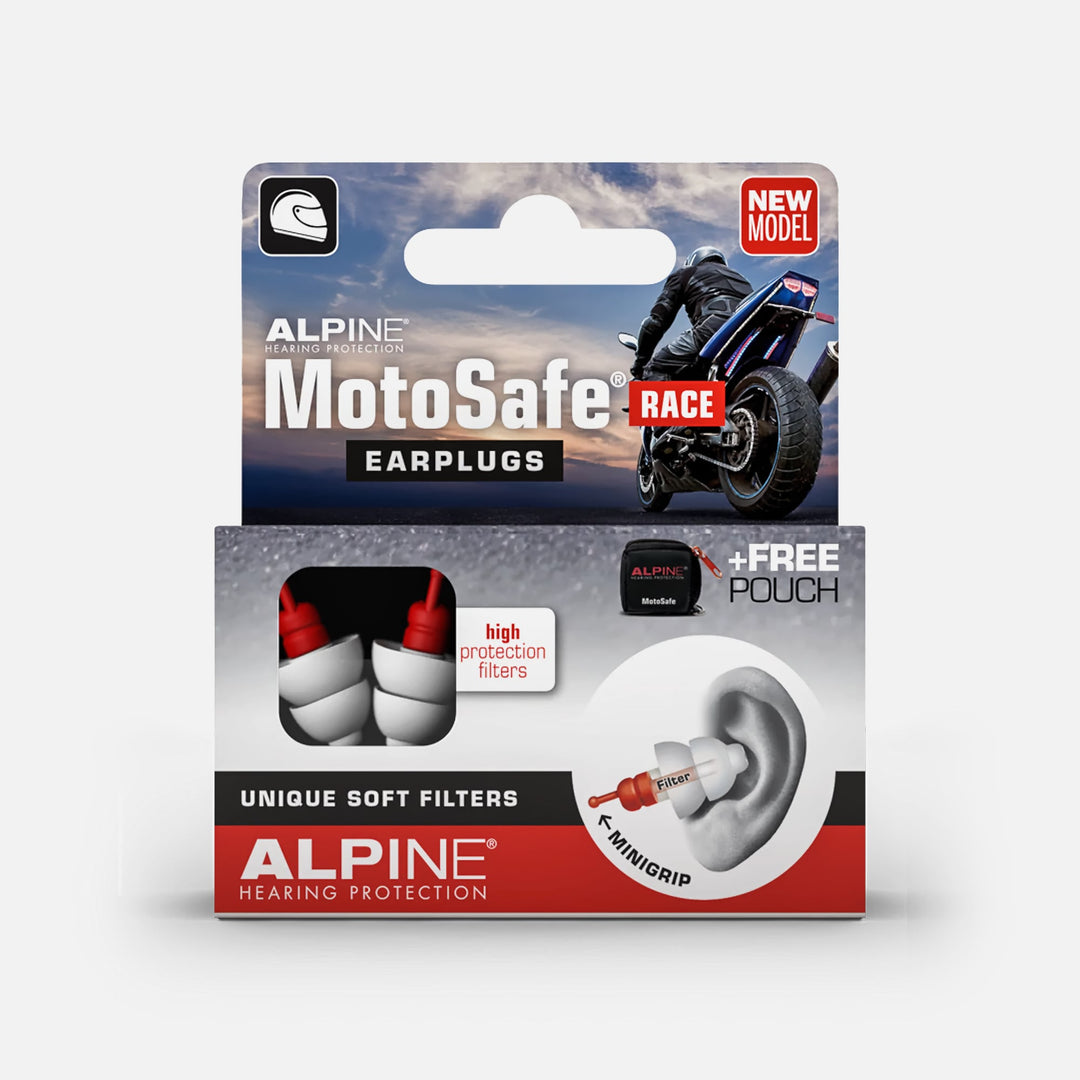
Although Alpine's MotoSafe range is primarily designed for motorcycle riding, its higher-attenuation Sport and Race versions are also designed for racetrack and high-noise riding environments.
Alpine MotoSafe Sport Motorcycle Earplugs provide 20 dB SNR attenuation and use AlpineAcousticFilters™ to reduce wind and ambient noise while keeping more useful surrounding sound audible.
The Alpine MotoSafe Race MotoGP™ Edition Motorcycle Earplugs provide the same published 20 dB SNR attenuation and the same published attenuation profile as MotoSafe Sport.
The main difference is presentation rather than hearing-protection performance. MotoSafe Sport is the standard version, while the MotoGP™ Edition features an official MotoGP™ licensed black-and-red design and comes with MotoGP™ branded accessories, including a case and lanyard.
For an F1 spectator, either model can therefore serve the same basic purpose: filtered noise reduction in a loud motorsport environment while retaining more of the surrounding sound than a conventional broad-attenuation foam earplug. Choose between them based mainly on your preferred design and accessories rather than expecting one to provide stronger noise reduction.
These MotoSafe models are not specifically designed for Formula 1 spectators, but their racetrack-oriented design makes them reasonable options for motorsport events. Correct fit remains essential, and laboratory attenuation ratings do not guarantee identical real-world protection for every wearer.
Over-ear hearing protection
Some spectators prefer earmuffs because they are easy to put on and remove and do not require inserting anything into the ear canal.
An adult option such as the Alpine Defender Earmuffs provides SNR 26 dB attenuation with an adjustable over-ear design.
Earmuffs are bulkier to carry than earplugs, but some people find them easier to wear consistently during a long event.
High-attenuation foam earplugs
Conventional foam earplugs remain useful when broad, relatively strong noise reduction is the priority.
For example, Mack's Ultra Soft Foam Earplugs carry an NRR of 33 dB and are intended for high-noise environments including motorsports.
Foam earplugs do not block all sound, but they generally reduce sound more broadly than filtered motorsport earplugs. Conversations, commentary and the character of engine sound may therefore feel more noticeably muffled.
If broad noise reduction is your main priority, that may be an acceptable trade-off. If you want to retain more of the live motorsport experience, a filtered design may feel more natural.
Do not directly compare SNR and NRR figures as though they are interchangeable. They come from different rating systems and test methods.
Can you still hear the race while wearing hearing protection?
Yes. Hearing protection reduces sound rather than making the environment silent.
Filtered motorsport earplugs such as MotoSafe Sport and MotoSafe Race MotoGP™ Edition are designed to reduce excessive sound while preserving more surrounding audio than conventional broad-attenuation plugs.
You should still expect engines, crowds and announcements to sound quieter—that is the purpose of hearing protection—but filtered designs can retain more environmental awareness and sound character.
Foam earplugs generally provide broader attenuation, so speech, commentary and engine sound may feel more muffled.
Neither approach is automatically best for everyone. The priority is adequate protection, proper fit and something you are comfortable wearing throughout the loud parts of the event.
Which option makes the most sense?
- Want filtered noise reduction while retaining more race atmosphere? MotoSafe Sport and MotoSafe Race MotoGP™ Edition offer the same published 20 dB SNR performance. Choose Sport for the standard version, or the MotoGP™ Edition if you prefer its official black-and-red design, branded case and lanyard.
- Prefer not to insert anything into your ears? Consider over-ear hearing protection such as Alpine Defender.
- Prioritise broad, high attenuation over sound clarity? Properly fitted foam earplugs such as Mack's Ultra Soft can be a practical option.
- Bringing children? Use age-appropriate hearing protection, with earmuffs often being easier for parents to fit and monitor.
Should children wear hearing protection at a race?
Children deserve particular consideration in very loud environments. They may not recognise that a sound level is excessive, may not tell you that their ears feel uncomfortable, and may remove protection if it is poorly fitted.
For babies and younger children, over-ear hearing protection is often practical because parents can immediately see whether it is positioned correctly.
For babies and younger children, Alpine Muffy Baby Comfort provides age-appropriate over-ear hearing protection with a soft headband design.
For older children, Alpine Muffy Kids is designed for children aged 5 to 16 and is intended for loud environments including motorsport events.
Whatever product you choose, check the fit before arriving at the event. A child who refuses to keep hearing protection on once the racing has started is difficult to protect effectively.
Earplugs or earmuffs for children?
Both can reduce noise when appropriate for the child's age and fitted correctly, but earmuffs have several practical advantages at motorsport events:
- Parents can immediately see whether they are positioned correctly.
- They are easy to put on before a loud session begins.
- They do not require inserting a small object into the ear canal.
- They are easy to remove and replace during quieter breaks.
For older children who are comfortable with earplugs, an age-appropriate product may also be an option, but always follow the manufacturer's age and fitting instructions.
Is stronger hearing protection always better?
Not automatically.
The aim is to achieve enough noise reduction for the environment while still maintaining useful awareness of what is happening around you.
Too little protection may not reduce exposure sufficiently. Unnecessarily high attenuation, on the other hand, can make communication and important environmental sounds harder to hear.
The practical priority is to choose hearing protection that fits properly, provides meaningful attenuation for the environment and is comfortable enough that you will actually keep wearing it.
Where you sit at the circuit also matters
Hearing protection is important, but it is not the only way to reduce exposure.
Your location can make a difference. Areas immediately beside the track, close to acceleration zones, enclosed grandstands or structures that reflect sound may feel considerably louder than areas farther away.
When possible:
- Increase your distance from the loudest sound sources.
- Use quieter areas for breaks between sessions.
- Avoid spending unnecessary time beside particularly loud sections of the circuit.
- Keep hearing protection in place during active track sessions rather than repeatedly removing it.
Should you wear hearing protection only during the main race?
No. A race weekend can include practice, qualifying, support races, demonstrations, concerts and other amplified entertainment.
Your ears respond to the total sound exposure, not just the main race.
If an area is loud enough that you need to raise your voice significantly to communicate at close range, or if the sound feels uncomfortable, putting your hearing protection on early is more sensible than waiting for your ears to begin ringing.
What should you pack for race day?
A simple hearing-protection plan can make the day easier:
- Bring hearing protection for every person attending.
- Keep it somewhere immediately accessible rather than at the bottom of a bag.
- Fit children's earmuffs before the first loud session.
- If using reusable earplugs, make sure they are clean before insertion.
- Carry a clean storage case for earplugs when they are removed.
- Take quieter breaks during a long day at the circuit.
If you are attending with children, do not wait until race day to introduce their earmuffs. A few short practice sessions at home can make them easier to accept in a busy and unfamiliar environment.
What if your ears ring after the race?
If you leave an event with ringing ears or muffled hearing, give your ears a quieter period and avoid unnecessary additional loud-noise exposure.
Persistent ringing, ongoing hearing changes or repeated symptoms after loud events should be discussed with a qualified hearing or healthcare professional.
Sudden significant hearing loss, particularly in one ear, requires prompt medical assessment.
The simple answer
Yes—hearing protection is a sensible part of preparing for an F1 race.
Exact sound exposure varies considerably between circuits and spectator locations, so there is no single noise level that describes every F1 event. Evidence from professional motorsport more broadly shows, however, that spectators can experience potentially hazardous noise exposure.
For adults who want to preserve more of the motorsport atmosphere, filtered earplugs such as Alpine MotoSafe Sport or MotoSafe Race MotoGP™ Edition are relevant options. Both provide the same published 20 dB SNR performance; the MotoGP™ Edition is primarily distinguished by its licensed design and accessories.
Over-ear hearing protection and high-attenuation foam earplugs provide alternative approaches depending on your priorities. For children, age-appropriate hearing protection deserves particular attention, and earmuffs are often a practical choice.
Good hearing protection should not stop you enjoying the race. Its purpose is to help make sure that when the cars stop, the sound you take home with you is not ringing in your ears.
This article provides general educational information and is not a substitute for individual hearing or medical advice from a qualified professional.


Leave a comment