

A motorcycle helmet is essential protective equipment, but riders sometimes assume that covering the ears inside a helmet also protects their hearing from noise.
That is not necessarily the case.
Motorcycle helmets are primarily designed to protect the head during an impact—not to function as certified hearing protectors. At speed, turbulent air moving around the helmet can generate substantial wind noise close to the ears, even when the motorcycle itself does not seem especially loud.
For riders who spend long periods on the road, understanding wind noise is an important part of protecting hearing over time.
Where does motorcycle wind noise come from?
At lower speeds, engine and traffic noise may be noticeable. As speed increases, however, airflow around the rider and helmet becomes increasingly important.
Air passing around the windscreen, helmet shell, visor, neck opening and shoulders creates turbulence. That turbulent airflow can produce broadband noise around the helmet and ears.
A review of motorcycle noise research reported that classic under-helmet measurements found wind noise around 90 dB(A) at approximately 60 km/h and rising to around 110 dB(A) at 160 km/h.
These figures should not be treated as universal measurements for every motorcycle or helmet. Actual exposure depends on many variables, including riding speed, helmet design, windscreen height, riding posture, weather and how airflow reaches the helmet.
The important point is the trend: wind noise can become very loud as riding speed increases.
Does a full-face helmet protect your hearing?
A full-face helmet can change the amount and character of sound reaching your ears, but that does not make it a hearing protector.
Research measuring sound inside motorcycle helmets has found that some helmets provide relatively poor attenuation at certain frequencies, particularly the low-frequency wind turbulence generated around the helmet shell.
Two helmets that feel equally solid can also produce very different noise environments depending on their aerodynamics, ventilation, visor design, fit and interaction with the motorcycle's windscreen.
So while choosing a quieter helmet may improve riding comfort, a helmet should not automatically be relied upon as your only protection against repeated wind-noise exposure.
Is wind noise really a hearing concern?
Repeated exposure to loud sound can damage hearing over time. The risk depends on both how loud the sound is and how long you are exposed to it.
The U.S. National Institute for Occupational Safety and Health (NIOSH) uses 85 dBA as its recommended occupational noise exposure limit over an eight-hour workday and emphasizes that correctly selected and properly fitted hearing protection is important when noise cannot otherwise be sufficiently reduced.
Motorcycle riding is not identical to an industrial workplace, but the same principle applies: as sound becomes louder, the amount of time that can be tolerated without increasing hearing risk becomes shorter.
Recent research continues to support concern about repeated motorcycle-noise exposure. A 2025 study of motorcycle couriers found elevated hearing thresholds at several frequencies compared with a control group, while a 2026 study of daily riders identified poorer performance on a test of fine auditory processing even though conventional hearing thresholds were not significantly different. These studies do not mean every rider will develop hearing loss, but they reinforce that repeated riding noise deserves attention.
Is the engine the main problem?
Not always.
A loud exhaust can certainly add to a rider's total noise exposure, but at road and highway speeds, wind turbulence around the helmet can become a major source of noise.
This explains why a rider on a relatively quiet motorcycle may still finish a long highway trip with ringing ears, muffled hearing or a sense of auditory fatigue.
It also explains why simply changing to a quieter exhaust does not necessarily solve the wind-noise problem.
What affects how much wind noise you hear?
There is no single noise level that applies to every rider. Important factors include:
- Speed: Higher speeds generally create stronger airflow and turbulence.
- Helmet design: Shell shape, visor seals, vents and the neck opening can all affect airflow.
- Helmet fit: Gaps around the helmet can change turbulence and sound.
- Windscreen height and shape: A windscreen may reduce airflow or redirect turbulence toward the helmet, depending on the setup.
- Riding position: Sitting upright, leaning forward or changing head position can change where turbulent air hits the helmet.
- Motorcycle type: Fairings and bodywork alter airflow around the rider.
- Weather: Headwinds, crosswinds and gusty conditions can increase turbulence.
- Ride duration: A moderate noise level experienced for several hours can matter more than a brief exposure.
This is why another rider's experience with the same helmet may not perfectly match yours.
What are signs that a ride may have been too loud?
Pay attention to how your hearing feels after a ride.
Possible warning signs include:
- Ringing or buzzing in the ears
- Temporary muffled hearing
- A feeling of fullness in the ears
- Sounds seeming unusually dull after removing your helmet
- Needing unusually high intercom or music volume
- Repeated hearing fatigue after longer rides
These symptoms do not tell you exactly how much hearing damage has occurred, but repeated ringing or muffled hearing after riding should not simply be accepted as normal.
Can motorcycle earplugs help?
Properly fitted earplugs can reduce the amount of sound reaching the ear. The key is using a product that fits correctly and provides an appropriate level of attenuation for the riding environment.
Motorcycle-specific filtered earplugs are designed differently from simply blocking as much sound as possible. Their purpose is to reduce wind and background noise while allowing useful sounds such as traffic, navigation, engine sound and intercom communication to remain audible.
For everyday riding and touring, Alpine MotoSafe Tour Motorcycle Earplugs provide 17 dB SNR attenuation and are intended for moderate riding conditions.
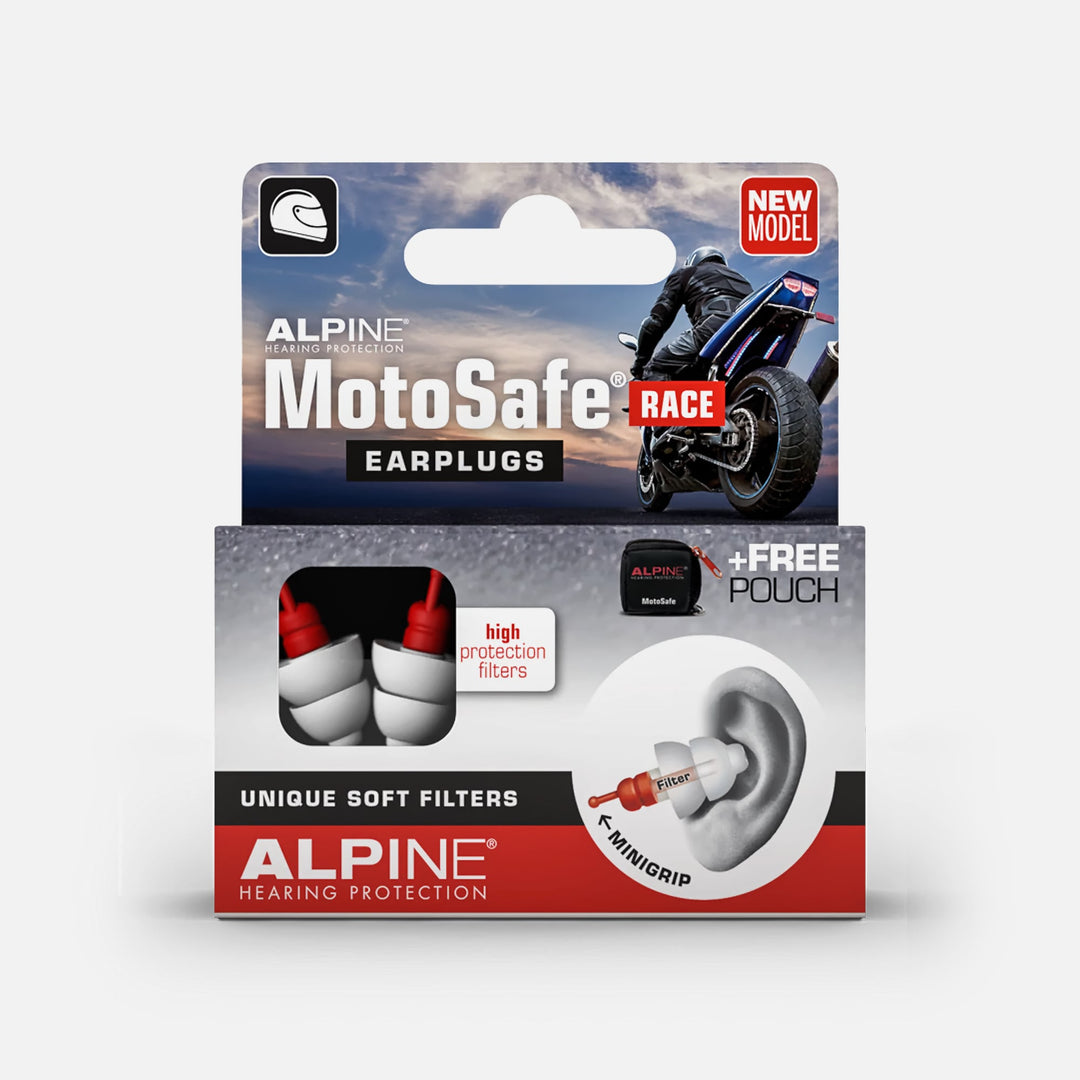
For highway riding, higher speeds, track use or more intense wind-noise conditions, Alpine MotoSafe Sport Motorcycle Earplugs provide 20 dB SNR attenuation.
Riders who regularly switch between relaxed touring and faster riding can use Alpine MotoSafe Duo Motorcycle Earplugs, which include both Tour and Sport earplugs.
You can also explore our Motorcycle Earplugs & Hearing Protection collection for the wider MotoSafe range.
Tour or Sport: which level makes sense?
The strongest earplug is not automatically the best choice for every ride.
MotoSafe Tour provides lighter attenuation and is suited to everyday riding, touring, holidays and secondary roads where wind noise is more moderate.
MotoSafe Sport provides stronger attenuation and is aimed at highway riding, racetrack use, higher speeds and other situations where wind noise can be more intense.
If your riding varies substantially, the Duo set avoids having to choose one attenuation level for every situation.
The important principle is to reduce excessive noise without unnecessarily isolating yourself from useful riding information.
Why not just use ordinary foam earplugs?
Foam earplugs can provide substantial sound reduction when fitted correctly, and for some riders they may be an effective option.
However, they generally focus on broad noise attenuation rather than balancing wind-noise reduction with the audibility of traffic, navigation and communication.
Filtered motorcycle earplugs are designed specifically around that compromise.
Whichever type you choose, fit matters. NIOSH notes that real-world protection can vary considerably depending on how well a hearing protector fits the individual user.
How should motorcycle earplugs fit under a helmet?
An earplug should sit securely without creating painful pressure when the helmet is put on.
Before riding:
- Insert the earplugs according to the manufacturer's instructions.
- Make sure each plug is seated comfortably and securely.
- Put on your helmet slowly so the helmet liner does not pull the earplugs loose.
- Check for pressure points around the ears.
- Confirm that important sounds remain sufficiently audible before entering traffic.
If one ear suddenly sounds much louder than the other while riding, the earplug may not be sealed correctly.
What else can reduce motorcycle wind noise?
Earplugs are only one part of the picture. Depending on your motorcycle and helmet, you may also be able to reduce noise by:
- Using a correctly fitting helmet
- Checking visor and helmet seals
- Experimenting with windscreen position or height where adjustable
- Avoiding unnecessary high speeds for long periods
- Taking quieter breaks during long rides
- Keeping intercom and music volume at a moderate level rather than turning them up to overpower wind noise
The goal is not to eliminate every sound. It is to reduce unnecessary exposure while maintaining the environmental awareness needed for riding.
When should a rider consider a hearing check?
Consider having your hearing assessed if you regularly experience:
- Ringing after rides
- Persistent muffled hearing
- Difficulty following conversations in background noise
- A noticeable difference between your ears
- A need to increase audio volume more than before
Sudden hearing loss, particularly in one ear, requires prompt medical assessment rather than simply changing earplugs or helmets.
The simple answer
A motorcycle helmet should not be assumed to provide adequate hearing protection from wind noise. Its primary job is impact protection, while turbulent airflow around the helmet can still generate substantial sound at riding speed.
The actual noise a rider experiences depends on speed, helmet, motorcycle, windscreen, posture and riding conditions. Long or frequent rides can therefore create meaningful cumulative noise exposure even on relatively quiet motorcycles.
A well-fitting helmet, sensible speed and ride duration, moderate intercom volume, and properly fitted motorcycle earplugs can all contribute to a quieter and more comfortable ride.
For earplugs, choose attenuation appropriate to the conditions rather than automatically assuming that maximum sound reduction is always best.
This article provides general educational information and is not a substitute for individual hearing or medical advice from a qualified professional.


Leave a comment